
AI is already telling your story. The question is whether it is using your words or someone else’s.
Imagine a high school teacher, donor, journalist, or concerned citizen opens ChatGPT and asks:
"What are the most effective ways communities can reduce plastic pollution?"
OR
"What causes plastic pollution in rivers and oceans?"
That person is no longer clicking through ten websites and comparing viewpoints. Instead, she is asking for a synthesized answer, a trusted summary, or a “best available understanding” of the issue.
The AI is acting as a research assistant, pulling together information from multiple sources and generating a coherent response.
Your content is out there, but you are not seeing any mentions or citations. You’ve written the web pages, blog posts, and reports, and AI is passing you by. AI may not overlook your content because it lacks expertise. In many cases, it may struggle to use it because the information is difficult to extract, verify, or reuse.
What is AI looking for? Trustworthy, reusable knowledge. AI systems are generally better at reusing clearly structured information than campaign-oriented storytelling.
Why Mission-Driven Content Often Gets Overlooked by AI
Many mission-driven writers will write copy that sounds like this:
Plastic pollution is a growing crisis affecting ecosystems and communities around the world. Through education, advocacy, and collective action, we can create a future free from plastic waste.
This works reasonably well for awareness campaigns, fundraising, and community engagement.
But it performs poorly as a unit of knowledge. The paragraph communicates importance, but it provides few signals of expertise that an LLM (Large Language Model) crawler can confidently reuse.
What Makes Information Easy for AI to Reuse
When answering a user’s question about plastic pollution, the AI is more likely to use language like:
More than 11 million metric tons of plastic enter the ocean every year, according to the United Nations Environment Programme. Studies suggest that reducing single-use plastics, improving waste collection systems, and implementing producer responsibility policies can significantly reduce plastic leakage into the environment.
Notice how sentences contain:
- A clear claim
- A measurable fact
- A recognizable source
- An identifiable action
Those elements are easy to extract and combine with information from other sources.
Why Content Can Be Rewritten by AI
Many nonprofit websites are designed primarily for donors, supporters, and campaign audiences. It’s probably narrative-heavy writing with good storytelling for engagement and donations. And that’s okay. That’s what you need to do.
Sometimes there are too many goals on one page. You are trying to educate, inspire, and often persuade readers to act. Key ideas are buried in long paragraphs, and context is assumed, requiring readers to read the whole page to understand your cause.
Content that is modular, verifiable, and easy to interpret is generally easier for AI systems to reuse. When similar information is expressed more clearly elsewhere, AI systems may rely on those sources when generating answers.
Narrative Drift
Here is an important concept you can share with your writers and content team: “Narrative Drift.” Narrative drift occurs when your work shows up in AI answers but no longer sounds like you (and fails to credit you).
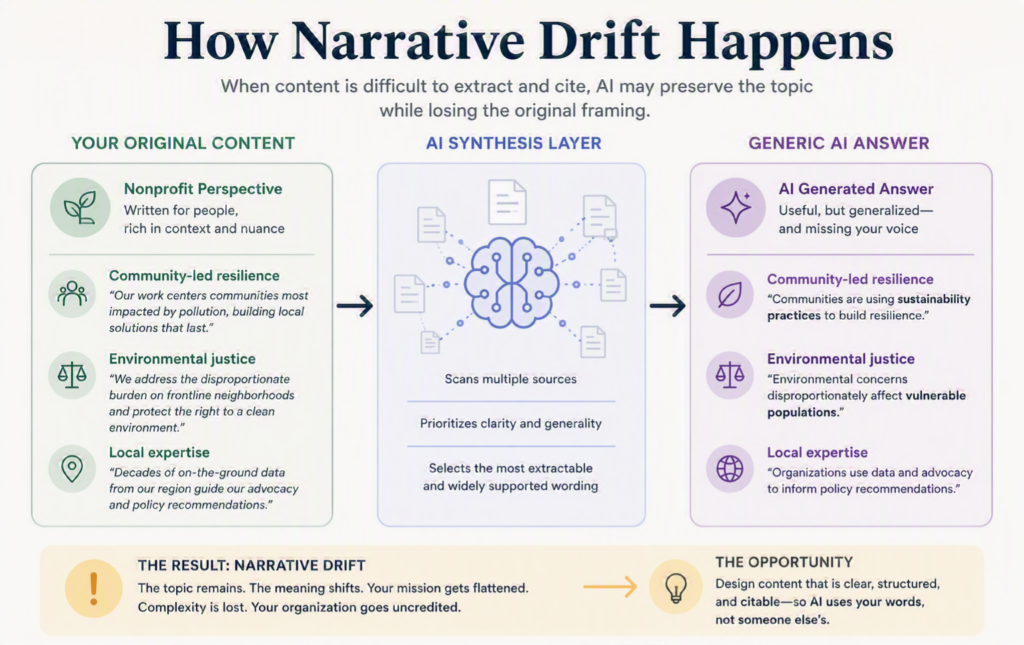
Narrative drift is a problem because your mission gets lost. Key complexities are removed from the results, and advocacy becomes watered down and generic. For example, you could be framing a conservation issue as community-led resilience, and AI may refer to it simply as “sustainability practices.”
The Publishing Shift You Need to Make
The old SEO model was to write, optimize, and publish content for high rankings on Google to drive traffic to your website. Searchers looked for blue links, and the entire game was ranking high enough to earn the click. The visitor saw your website before they saw an answer.
Searchers are not just clicking on blue links anymore. Half of all searchers are turning to AI search, using engines like ChatGPT, Copilot, Claude, and Perplexity.
Traditional SEO still matters while AI search adds new layers such as answers, summaries, citations, and recommendations. AI search engines are focused on intent, aiding searchers from a variety of angles.
| Old SEO Model (Blue Links) | New AI Search Model (Answers) |
| Publish content to earn high rankings | Build content AI can understand and cite |
| Users click blue links to reach your site | Users see answers before deciding to visit a site |
| Success = rankings and click traffic | Success = brand mentions and citations |
Users’ topics haven’t changed, but the way they research has. The new publishing model rewards you for being understandable, credible, mentioned, and cited.
Your goal isn’t just to publish ideas; it’s to make them durable in AI systems.
What AI Needs from Your Content
There are three crucial requirements.
1. Clarity
You need to be crystal clear about what your organization does. Direct statements written in a natural user language are important. Don’t embed your insights, rather structure information so that the data and takeaways are crystal clear.
2. Evidence
Assertions and passion are okay to have in your copy, but do look to have more specifics, proof points, examples, and case studies to bolster your claims and AI’s faith in your expertise.
3. Modularity
Some content needs to work in fragments, presenting structured nuggets of information that can be reused effectively by AI in its synopses. Good page headings or FAQs are ways to present structure to LLM crawlers.
AI-Citable Design
Your core framework moving forward is to publish with AI-citable design standards.
What is AI-Citable Design?
AI-Citable Design is the practice of structuring content so its meaning can be directly reused without being reinterpreted. OR AI-Citable Design is the practice of organizing, structuring, and presenting information so that large language models can accurately identify, extract, verify, attribute, and reuse it when generating answers.
While traditional SEO work was designed for crawler, indexing, ranking, and clicks, today’s optimization work, often referred to as AEO (answer engine optimization), is designed for extraction, synthesis, citation, attribution, and answer generation.
Simply put, SEO helps content get found, and AI-citable design helps content get reused.
The Smallest Unit of Influence – The Sentence
AI doesn’t cite pages; it cites statements. Influence happens at the sentence level. Key passages and sentences should include:
Information Atomicity – Break valuable information into reusable units. Examples include definitions, lists, comparison tables, and steps.
Answerability – Key sections should answer a question. For example, What is it? Why is it important? How does it compare? Directly answering common user questions increases citation probability.
Extractability – Content should be easy for an LLM to isolate. Write some important sentences so that they can be lifted directly into an answer. For example, provide a clear definition of a problem in one sentence.
Five Tips for AI-Citable Design
1. Start with citation units. A citation unit is the smallest block of content that can stand on its own when extracted from the page. You can think of definitions, statistics, steps, and comparisons. Every page should contain multiple self-contained citation units.
2. Consider signal density. Signal density is the amount of useful information relative to the amount of filler. Sentences that send strong signals include use cases, statistics, and deeper context. Think more facts and less introductions.
3. Understand extraction clarity. Can an AI determine exactly what you’re saying? Clarity means having little to no ambiguity. Strive to have one idea per sentence and one meaning per paragraph.
4. Write for definitions first. Definition-first writing is quite simply defining something first. You can explain and expand later.
5. Give answers to questions immediately. Many writers build toward an answer. AI wants the answer immediately. An answer-first structure is leading with an answer. Lead with the takeaway and not the story.
Ethical Visibility Means Making Your Truth Easy to Cite
The opportunity in front of you is meeting the challenge posed by AI systems. Knowing that LLMs prefer grounded claims, non-sensational language, and clarity, you can amplify your message to more people. If you don’t bring AI-Citable design thinking to your communications efforts, others will define your issue space.
Quick AI Visibility Self-Audit
Are you losing your voice? If AI quoted your content today:
- Would it capture your story?
- Would it include your perspective?
- Would it sound like you?
- Would at least one insight come from you?
Be the AI-Cited Author of Your Mission
In the search era, visibility came from ranking. In the AI era, visibility comes from contribution.
Many nonprofits already possess deep expertise, trusted relationships, and valuable knowledge. Yet expertise alone is no longer enough. Knowledge must also be understandable, extractable, and reusable.
The future belongs to organizations that can turn their expertise into trusted, citation-ready knowledge.
Because in an AI-mediated world, it’s not enough to have the answer. You have to make it easy to become part of the answer.